
Company News
2020-08-26
770Since its establishment, Guangmai Electronics has established the corporate vision of "becoming an expert in overall electronic material solutions and a pioneer and leader in the global materials industry", and has always adhered to the corporate mission of "providing customers with the highest quality assurance and the most professional services".
Therefore, Guangmai Electronics has always attached great importance to continuous investment in product research and development and product testing capabilities. A professional polymer material testing laboratory, Dongguan Guangmai Electronic Technology Co., Ltd. Testing Center, covering an area of about 500 square meters, has been specially designed and renovated in the Songshan Lake headquarters office building in Dongguan.
Since its establishment, the positioning of the testing center has been to build an international advanced materials laboratory with advanced testing equipment and supporting facilities, complete testing technology, reasonable personnel structure, and scientific management methods.
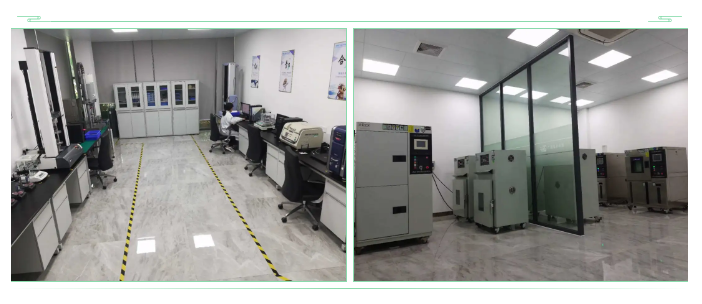
Advanced testing equipment
The testing center has invested over 10 million yuan to introduce multiple sets of world-class polymer material performance testing equipment and research and development instruments.
The main equipment includes:
Shimadzu Universal Testing Machine, Japan
Instron universal testing machine from the United States
German Naichi DMA (Dynamic Thermomechanical Analyzer) equipment
Agilent GC/MS (gas chromatography-mass spectrometry) from the United States
German Naichi Thermal Conductivity Tester
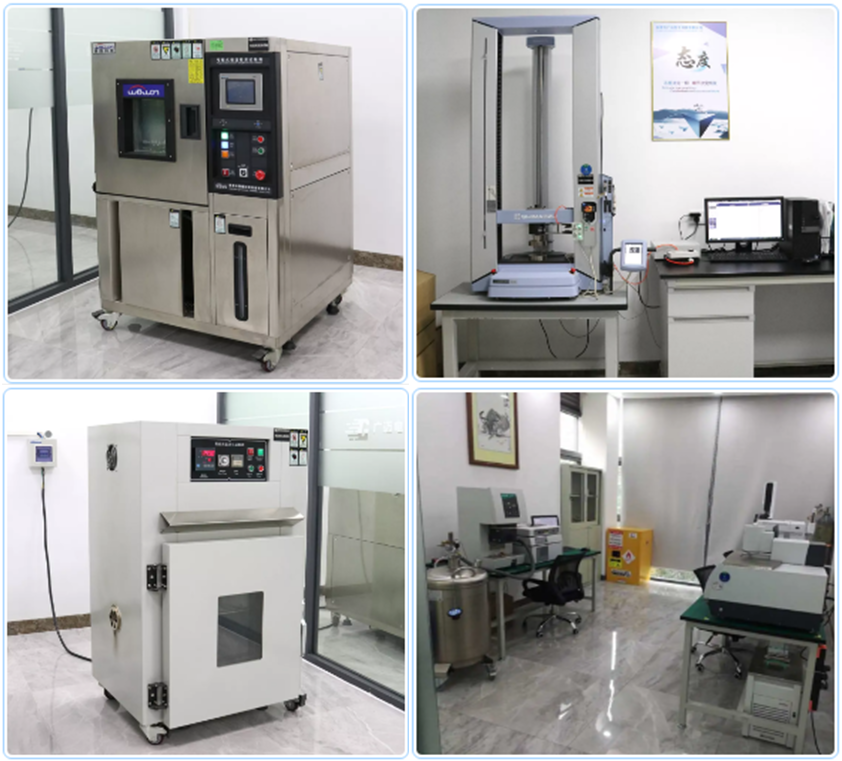
Complete testing items
The testing center can conduct various performance tests on polyurethane foam materials, silicone foam materials, and other high molecular weight organic silicone materials.
Material mechanical performance testing (thickness, density, hardness, tensile performance, bending performance, compression performance, tear resistance, etc.)
Aging environment testing (salt spray test, high temperature aging test, high and low temperature impact test, high temperature and high humidity test, repeated compression test)
RoHS testing
Thermal conductivity test
Combustion test (vertical and horizontal combustion)
Reliability testing (vibration, mechanical shock and drop testing, waterproof testing, fatigue testing)
Testing of Dynamic Mechanical Properties of Materials with Temperature, Time, and Frequency Variations (DMA)
Material composition analysis (GC-MS testing equipment)
Electrical performance testing (surface resistance, volume resistance, breakdown voltage, etc.)
Talent team construction
Our testing center attaches great importance to the construction of a talent team. Currently, we have a high-quality research and testing talent team with rich experience and a reasonable structure, who graduated from well-known domestic universities majoring in materials/chemical engineering. Among them, 50% are master's students, laying a very solid talent foundation for specialized research on polymer materials.
Management system construction
In addition to hardware construction and talent team training, Guangmai Electronic Testing Center also attaches great importance to the construction of testing capabilities and the establishment of an international mutual recognition system for quality management. In August 2019, Guangmai Electronic Testing Center began to introduce the CNAS system (ISO/IEC 17025 standard), and has now entered the critical stage of system introduction: internal audit and management review. It is expected to conduct on-site review in October this year and is expected to obtain a one-time pass.
Expand Reading
What is CNAS accreditation?
The China National Accreditation Service for Conformity Assessment (CNAS) is a national accreditation body approved and authorized by the Certification and Accreditation Administration of China. It is responsible for the accreditation of certification bodies, laboratories, and inspection agencies. It was formed by the merger and reorganization of the original Chinese certification bodies, the China National Accreditation Service for Conformity Assessment (CNAB) and the China National Accreditation Service for Laboratories (CNAL).
CNAS accreditation related processes
The implementation of ISO/IEC 17025 standard in the laboratory to CNAS accreditation generally requires four stages:
System standard documentation stage
Document release and implementation phase
Internal audit and management review stage
Application for recognition and evaluation stage
During the import process, there will also be training on CNAS internal auditor qualifications and specialized skills for laboratory personnel.
The significance of obtaining CNAS certification
Through CNAS laboratory accreditation certification, it indicates that the laboratory's testing capabilities have reached the national level laboratory level, marking that its quality management system fully complies with international standards and its testing technology capabilities have reached the international advanced level.
The benefits of importing CNAS
1. Elevate the hardware conditions of the laboratory (personnel, equipment, material conditions, testing or calibration methods, facilities, and environment) to a new level, indicating that the laboratory has the technical capability to provide testing and/or calibration services in accordance with relevant internationally recognized standards
2. Take the software conditions (file management and quality management) of the laboratory to a new level, improve internal management, eliminate management blind spots, and manage the daily work of various departments and positions in an orderly manner
3. Listed in the approved accreditation institution directory of the China Accreditation Service for Conformity Assessment or the China National Accreditation Service for Conformity Assessment, and electronically registered and published on the official website to enhance the laboratory's visibility
4. The CNAS national laboratory accreditation mark and ILAC international mutual recognition joint mark can be used within the scope of accreditation to obtain recognition from laboratory accreditation bodies in countries and regions that have signed mutual recognition agreements with CNAS
5. Enhance market competitiveness and win the trust of government departments and various sectors of society
6. Have the opportunity to participate in bilateral and multilateral cooperation and exchanges recognized by international qualification assessment agencies
Recommend


#Follow us#
东莞市广迈电子科技有限公司 版权所有 备案号:粤ICP备18121906号 技术支持:汇卓网络